




Psychometrics of Relationship with Intelli7®

academy softskills


Intelli7® invents Relationship Psychometrics.

In 1+1=3, discover the specifics of this
additional 1.

Differences in priorities, stakes, hooked aromas, conflicts, ...
it's all there.

<strong>Differences in<br>Drivers</strong>

Differences in
Drivers


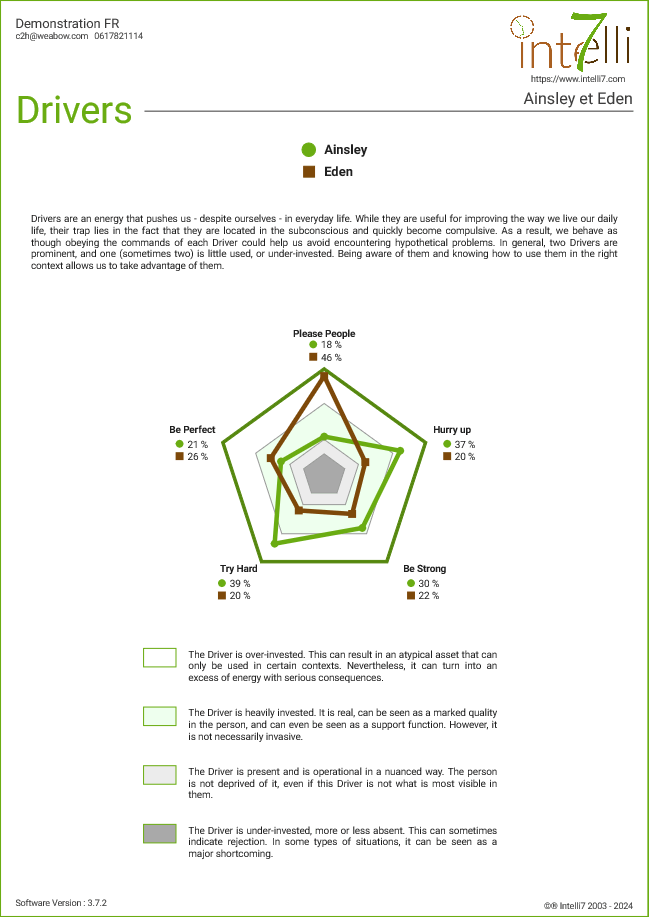
First, a global review on Drivers (Taibi Kahler), highlights the differences in style between the 2 people.

This translates into different priorities, and also different rhythms.

Drivers show a fundamental posture in people: it's impossible to overlook this information.

Remember that in Intelli7®, Drivers are understood to be assets, Differences that make the Difference.

In this diagram, we see one person in green, and the other in brown.

It's easy to identify the gaps and similarities in their respective Postures.


<strong>Differences in<br>SoftSkills</strong>

Differences in
SoftSkills


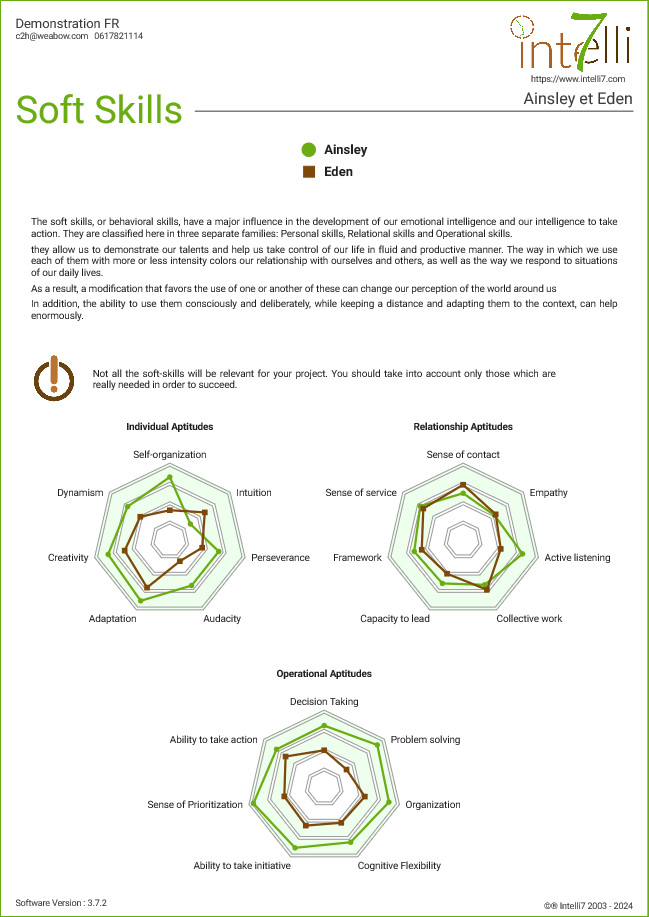
Then, a global review on SoftSkills, also highlights the differences in Postures and aptitudes between the 2 people.

This translates into different pespectives and choices

SoftSkills are a practical tool for anticipating people's tastes and attractions.


<strong>Differences in<br>Behaviors</strong>

Differences in
Behaviors


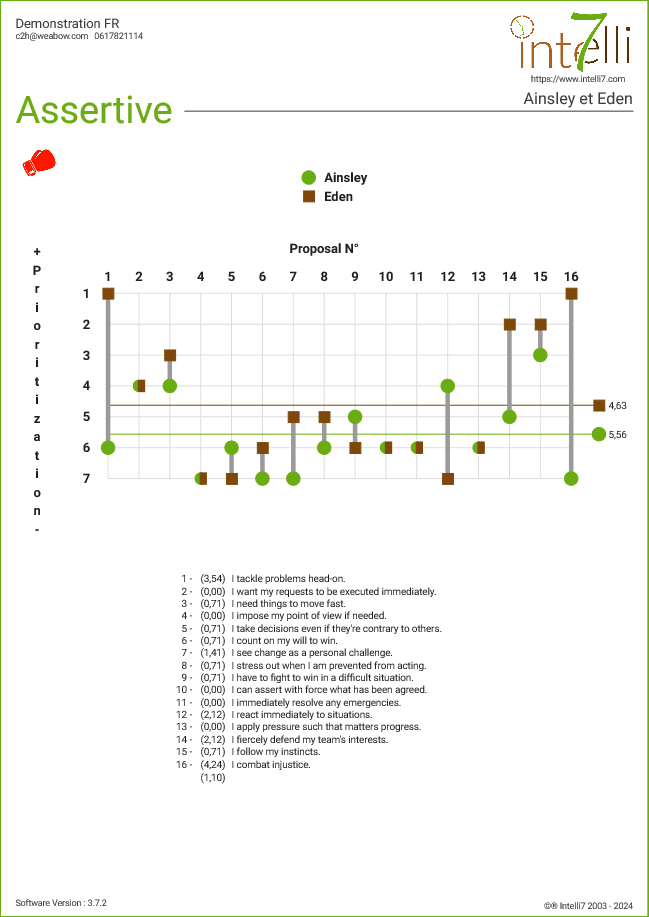
Intelli7® highlights Behaviors. These indicate how each person will act.

The Relationship highlights the differences and similarities in priorities between them.

Thus, a difference, or similarity, in Behaviors indicates:

  • a difference in actions, and these may or may not collide; the hierarchical position may or may not be helpful,
  • a difference in values, and thus the 2 representations of the world may or may not contradict each other,
  • complementarity, which may slide into a territorial issue,
  • and many other things that Intelli7® shows you. ..

Intelli7® provides many other tools for understanding Relationships.

The applications are many: relationship diagnostics (to anticipate the success of a collaboration or association between 2 people), relationship installation (much used in recruitment between n & n+1), conflict management, etc.

These animations are much appreciated by their participants as they allow real talk in complete safety.

soledad kaercher
<span style='font-size:1rem;'><strong>Soledad KAERCHER</strong></span><br>Strasbourg - France <br><a style='font-size:0.7rem; text-transform: lowercase; text-decoration:underline' href='https://www.soledadkaercher.fr' target='_blank'>www.soledadkaercher.fr</a>

Soledad KAERCHER
Strasbourg - France
www.soledadkaercher.fr


Professional Coach - NLP Master Practitioner - Collective Intelligence Facilitator

What I particularly like about the approach is that it's dynamic and doesn't put people in boxes. Intelli7 sheds light on the way a person and/or team operates.

I use it on an individual basis, to help my clients unblock situations quickly and concretely, based on behaviors that may be limiting and/or overused.

My clients gain a better grasp of their own resources in a concrete way. The realizations are powerful and lead to rapid action.

To make my collective interventions more fun, I've co-constructed a card game based on the Intelli7 approach. It's a fast way to create links between individuals and to allow exchanges on the way each one works.

This is an opportunity to get them thinking about the impact of using these behavioral practices on the project, on their managerial posture, or to cope with change ... and to align themselves with the practices to co-construct an action plan. Exchanges are smoother and make it easier to understand the model.

Intelli7 is a real asset in my coaching, enabling me to better understand the functioning of the person or group I'm coaching, to create a rapid alliance and adapt my coaching style accordingly.


To discover the card game:
Click here or Click here


puceMy references:
Eurométropole Strasbourg, CESI, Grand Meuse Sud, C2T, adidas ...

regis de charette
<span style='font-size:1rem;'><strong>Régis de Charette</strong></span><br>COS-FI, Aix en Provence<br><a style='font-size:0.7rem; text-transform: lowercase; text-decoration:underline' href='https://www.formation-intelligencecollective.com' target='_blank'>www.formation-intelligencecollective.com</a>

Régis de Charette
COS-FI, Aix en Provence
www.formation-intelligencecollective.com


Collective Intelligence facilitator, trainer, supervisor

Training

I've been using intelli7 since 2014 in individual and group coaching, and I appreciate the many possibilities of the approach and the very open notion of Dynamics.

Using the behavioral preferences of individuals and those of the group, I enable everyone to objectify their talents within the group's working framework. These insights reveal to the group people in comfort zones, under-utilized talents, over-adapted people as well as collective avoidances.

This also enables people to quickly regulate their relationships within the group. It provides an objective framework for expressing preferences, communicating better in the other person's world, asking the right questions and avoiding misunderstandings that are often mis-expressed.

This twofold work on relationships and preferences within the group ensures that the group's dynamics are set in motion in a very short space of time. It greatly facilitates training work, which can then be targeted to unblock energy, and encourage setting in motion.

Managerial assessment

The managerial assessment enables experienced managers in career development to refine, reposition and confirm their professional project by objectifying behavioral competencies in addition to the technical skills dealt with elsewhere (skills assessment, for example).

In this assessment, people are asked to define their own management style. They build on their behavioral preferences and can better contextualize their Soft Skills.

In peer groups, people can discuss their behaviors and become aware of different ways of reacting in a given situation by sharing on the effects.

Then they are led to work on the perception of the most suitable behaviors for one or more envisaged positions. These perceptions are compared with the perceptions of a panel chosen by them, made up of hierarchical superiors, HR, colleagues, ...

The comparison of their behavioral preferences and perceptions of the positions naturally creates a framework of contrasts which, after analysis, enables the implementation of an adapted action plan.


puceMy references:
INRA, CNRS, university, Valimovia (real estate), STI, city of Marseille, CD13

Copyright Intelli7.com - 2025